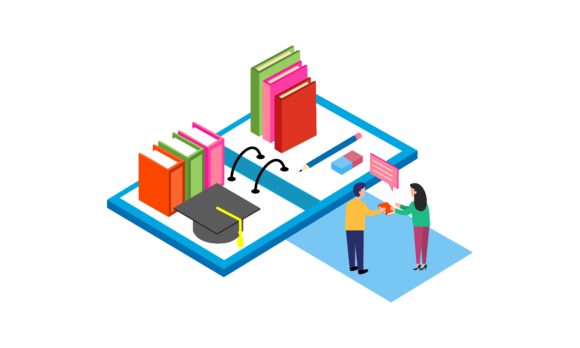
Evaluating Isometric Education Illustration for Modern School Projects
In the rapidly evolving landscape of digital content creation, visual consistency is often the differentiator between amateur presentations and professional-grade educational materials. For educators, instructional designers, and marketing professionals working within the education sector, finding assets that balance aesthetic appeal with technical flexibility is a persistent challenge. This is where Isometric Education Illustration, School sets emerge as a significant resource. These graphics are not merely decorative elements; they are functional tools designed to streamline the workflow of creators who need to communicate complex academic concepts clearly and engagingly.
The shift toward isometric design in educational contexts is driven by its unique ability to represent three-dimensional spaces on two-dimensional planes without perspective distortion. This style allows for a clean, organized presentation of classrooms, laboratories, libraries, and campus environments. When evaluating a specific asset pack labeled under this category, it is essential to look beyond the surface-level aesthetics and consider the practical implications of file formats, scalability, and integration ease.
The Strategic Value of Isometric Design in Learning Materials
Isometric illustrations have gained traction because they offer a neutral, objective viewpoint that is particularly well-suited for educational diagrams and infographics. Unlike realistic photography, which can be cluttered with distracting details, or flat design, which may lack depth, isometric art provides a structured yet inviting visual language. For schools and educational publishers, this means creating materials that feel modern and approachable while maintaining a high degree of clarity.
The primary strength of an Isometric Education Illustration, School collection lies in its modularity. High-quality packs are typically constructed with separate layers or distinct elements that can be rearranged to create custom scenes. This flexibility allows a single asset purchase to serve multiple purposes. A marketer might use the same classroom base to depict a traditional lecture setting in one brochure and a collaborative workshop environment in another, simply by swapping out furniture or student figures. This adaptability significantly extends the long-term value of the resource, reducing the need to commission custom artwork for every new project.
Technical Specifications and Usability
When assessing the utility of these graphics, the included file types are a critical factor. The standard download for professional-grade illustration packs usually contains both JPG and EPS files. Understanding the distinction between these formats is vital for maximizing their potential in your workflow.
- JPG Files: These are raster images, ideal for quick implementation in web-based projects, social media posts, or slide decks where editing is not required. They are universally compatible and easy to insert into any software, from Microsoft PowerPoint to basic blog editors. However, they are resolution-dependent, meaning they may lose quality if scaled up significantly.
- EPS Files: Encapsulated PostScript files are vector-based. This is the cornerstone of professional usability. Vector graphics can be scaled to any size without losing clarity, making them perfect for large-format printing such as banners, textbooks, or wall murals. Furthermore, EPS files can be opened and edited in industry-standard software like Adobe Illustrator, CorelDRAW, or Affinity Designer. This allows users to change colors to match institutional branding, adjust line weights, or isolate specific elements for custom compositions.
The claim that these graphics are "very easy to apply with any software" holds true primarily due to this dual-format approach. For users with limited design experience, the JPGs provide a plug-and-play solution. For advanced designers, the EPS files offer a robust foundation for customization. This inclusivity ensures that the asset pack serves a broad audience, from freelance bloggers needing quick visuals to corporate training departments requiring branded, high-resolution materials.
Quality Consistency and Visual Cohesion
One of the most common pitfalls in assembling educational resources is visual inconsistency. Mixing clip art from different sources often results in a disjointed appearance that undermines credibility. A curated Isometric Education Illustration, School set mitigates this risk by providing a cohesive visual library. All elements share the same lighting angles, color palettes, and line styles.
This consistency is crucial for building trust with the audience. Whether you are designing an online course module, a university prospectus, or an internal training manual, a unified visual style signals professionalism and attention to detail. It helps learners focus on the content rather than being distracted by mismatched graphics. Moreover, consistent branding across all touchpoints reinforces institutional identity, which is particularly valuable for private schools, ed-tech startups, and educational consultants.
Practical Applications for Diverse Professionals
The versatility of isometric school illustrations makes them relevant to a wide range of professionals. Here is how different users might leverage these assets effectively:
- Educators and Instructional Designers: Use the graphics to break down complex spatial concepts, such as laboratory safety layouts or library organization systems. The clear, diagrammatic nature of isometric art aids in cognitive processing.
- Marketers and Advertisers: Create eye-catching social media campaigns or email newsletters that stand out in crowded feeds. The playful yet professional aesthetic of isometric design tends to perform well in digital marketing contexts.
- Publishers and Authors: Enhance textbooks and e-books with engaging visuals that complement the text. The scalability of EPS files ensures that illustrations remain crisp regardless of the print size.
- Web Developers and UI Designers: Incorporate lightweight SVG conversions of the EPS files into website interfaces for landing pages, feature explanations, or interactive tutorials.
For small business owners in the tutoring or coaching sector, these illustrations offer a cost-effective way to elevate their brand presence. Instead of hiring a graphic designer for every promotional material, they can build a library of reusable assets that maintain a high standard of quality.
Limitations and Considerations
While Isometric Education Illustration, School packs are highly useful, they are not a universal solution. Users should be aware of certain limitations. First, the isometric perspective is rigid; it may not suit every narrative context. For emotional or highly dynamic storytelling, photographic or hand-drawn illustrative styles might be more appropriate. Second, while EPS files are editable, modifying them requires a certain level of technical proficiency with vector software. Users unfamiliar with bezier curves or layer management may find the learning curve steep, though numerous online tutorials can bridge this gap.
Additionally, because isometric design has become popular, there is a risk of visual saturation. To maintain uniqueness, it is advisable to customize the color schemes and combine elements in novel ways rather than using the pre-composed scenes exactly as provided. Adding subtle textures or integrating the illustrations with other design elements can help differentiate your content from competitors using similar stock assets.
Final Assessment of Long-Term Value
Investing in a high-quality Isometric Education Illustration, School package is a strategic decision for anyone involved in creating educational content. The combination of JPG convenience and EPS flexibility ensures that the assets remain useful across various platforms and project scales. The time saved in sourcing individual elements and ensuring visual consistency often outweighs the initial cost of the download.
For professionals seeking to enhance their visual communication without compromising on quality or budget, these graphics offer a balanced solution. They provide the structural clarity needed for effective teaching and the aesthetic polish required for compelling marketing. By understanding the technical capabilities of the included file types and applying them thoughtfully within a broader design strategy, users can maximize the impact of their educational materials. Ultimately, the value lies not just in the images themselves, but in the efficiency and professionalism they bring to the creative process.