Mastering School Timetable Template Design 01
Organization is the silent engine of effective education. For educators, administrators, and even proactive parents, the visual structure of a school week can dictate the flow of learning itself. School Timetable Template Design 01 emerges not merely as a grid of empty boxes, but as a foundational tool for clarity and routine. This specific design offers a balanced approach to scheduling, merging aesthetic simplicity with functional rigor. It serves as a canvas where time management meets pedagogical strategy, allowing users to map out complex academic schedules without the clutter that often plagues digital planners.
The value of this template lies in its versatility. Whether you are a graphic designer creating resources for an educational marketplace, a teacher organizing a semester, or a parent homeschooling children, the underlying structure provides a reliable framework. By starting with a pre-designed layout, you save hours of formatting time, allowing you to focus on the content that truly matters: the curriculum and the students.
The Anatomy of Effective Schedule Design
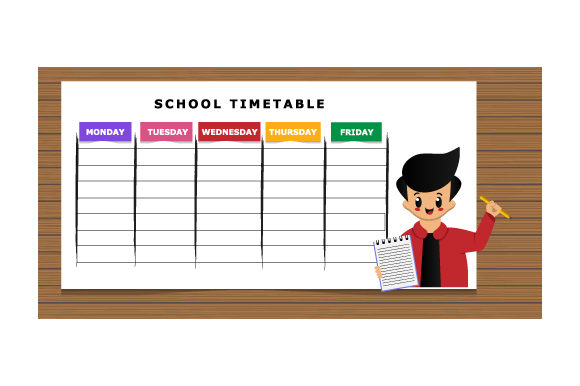
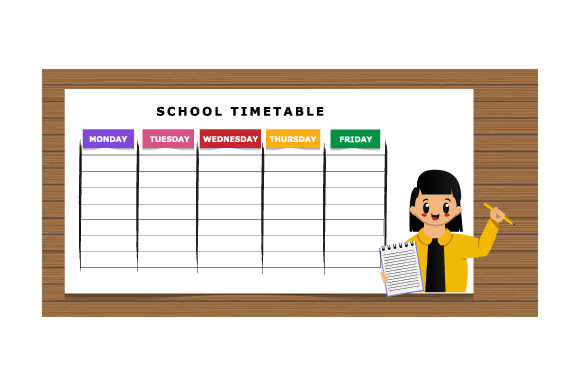
What makes School Timetable Template Design 01 particularly interesting is its adherence to cognitive ease. The human brain processes structured information faster than chaotic data. This template utilizes clear delineations between time slots and subject areas, ensuring that the viewer can instantly grasp the day’s flow. The design typically features generous whitespace, which prevents visual overcrowding—a common pitfall in traditional printed timetables.
For designers and creators, the availability of multiple file formats—AI, EPS, JPG, and PNG—transforms this template from a static document into a dynamic asset. The vector files (AI and EPS) allow for infinite scalability without loss of quality, meaning you can resize the timetable for a massive classroom poster or a tiny planner insert with equal precision. Meanwhile, the raster formats (JPG and PNG) offer immediate usability for digital sharing, social media previews, or quick printing without requiring specialized software.
Creative Applications for Educators and Designers
Beyond its primary function as a weekly planner, this template invites creative interpretation. Here is how different professionals can adapt it for their specific needs:
- Custom Classroom Posters: Teachers can use the AI files to inject school colors, mascots, or thematic elements that resonate with their students. A biology teacher might add subtle leaf motifs, while a history teacher could incorporate vintage typography.
- Digital Planning Integration: Freelancers and productivity bloggers can convert the PNG files into digital stickers or overlays for apps like GoodNotes or Notability. This bridges the gap between traditional print and modern digital organization.
- Homeschool Curricula: Parents managing multi-age households can use the template to create overlapping schedules. The clear structure helps distinguish between independent study time and group activities, reducing household friction.
- Event Scheduling: Small business owners running workshops or summer camps can repurpose the grid layout to track instructor rotations, room assignments, and break times, ensuring smooth operational flow.
Adapting the Template for Print and Digital Contexts
When preparing School Timetable Template Design 01 for print paper education contexts, attention to detail is paramount. The EPS format is ideal here because it supports CMYK color profiles, ensuring that the printed colors match your digital preview. For black-and-white printing, which is common in schools to save costs, the high-contrast lines of the design ensure readability remains intact. It is advisable to test print a single page first to check margin alignment, especially if you plan to bind multiple weeks into a semester planner.
For digital contexts, such as email newsletters or blog posts about education tips, the JPG format offers a lightweight solution. However, ensure you optimize the image size to maintain fast loading speeds without sacrificing legibility. If you are using the template as part of a larger graphic design project, the transparent background of the PNG file allows for seamless layering over textured backgrounds or photographic elements.
Enhancing Usability Through Customization
To keep results clear and effective, consider the end-user’s experience. If you are distributing this template to other teachers or selling it as a digital product, provide variations. Some users prefer a Monday-to-Friday layout, while others need a seven-day view for extracurricular tracking. Using the editable AI files, you can easily duplicate columns or adjust row heights to accommodate longer class periods or short breaks.
Consistency is key to audience-friendly design. Stick to a limited color palette—no more than three primary colors—to avoid visual noise. Use bold fonts for headers and lighter weights for details. This hierarchy guides the eye naturally through the schedule. Furthermore, consider adding a small section for "Weekly Goals" or "Notes" at the bottom of the template. This small addition transforms the timetable from a passive record of time into an active planning tool.
Practical Inspiration for Project Ideas
Let us explore some concrete project ideas that leverage this template’s strengths. Imagine a school administrator needing to present the annual schedule to the board. Instead of a dry spreadsheet, they use School Timetable Template Design 01 to create a visually engaging infographic. The clean lines and professional look lend credibility to the presentation.
Alternatively, a stationery entrepreneur could bundle this template with matching homework trackers and attendance logs. By maintaining a consistent design language across all products, they build a recognizable brand identity. The template serves as the anchor for a broader suite of organizational tools.
For hobbyists and journal enthusiasts, the template can be printed on cardstock and used as a base for bullet journaling. Users can hand-letter subjects, add washi tape borders, or stamp icons next to specific classes. This tactile interaction with the schedule increases engagement and makes the act of planning enjoyable rather than chore-like.
Ensuring Originality and Relevance
While templates provide a starting point, originality comes from how you populate them. Avoid generic labels like "Math" or "English" if you can be more specific. Use terms like "Algebraic Thinking" or "Creative Writing Workshop" to reflect the actual nature of the lessons. This specificity adds value for the user and makes the schedule more informative.
Moreover, consider the accessibility of your final design. Ensure there is sufficient contrast between text and background. If you are adding color coding for different subjects, include a legend or key. This ensures that color-blind users or those viewing printed copies in poor light can still interpret the schedule accurately.
In conclusion, School Timetable Template Design 01 is more than a simple grid. It is a versatile resource that supports organization, creativity, and efficiency. By understanding its technical capabilities and exploring diverse applications, creators and educators can transform a basic schedule into a powerful tool for success. Whether you are designing for print, digital, or hybrid environments, this template offers the structural integrity needed to bring order to the chaos of academic life.